Showing posts with label Sea Life. Show all posts

Monday, April 27, 2009

Pistol Shrimp


Pistol Shrimps are tiny creatures with a deadly weapon. They are capable of shooting supersonic blasts from their fingertips with enough force to instantly stun or kill their prey.


You may notice that one claw of a pistol shrimp is much larger than the other, and very strangely shaped. This claw serves as both its lethal weapon, and its voice. This claw can be forcefully snapped shut, shooting a jet of water out at such a high speed that it actually vaporizes the water. This causes a small air bubble to form. The bubble collapses with enough force to send concussive shockwaves capable of stunning and incapacitating prey.

A pistol shrimp will lie in wait under a rock or in a burrow until food comes along. When it is in range, the shrimp will forcefully snap its oversize claw shut, shooting out sonic waves that incapacitate its prey. The helpless victim is dragged unconscious into the burrow and eaten by the pistol shrimp.

Another unusual thing about pistol shrimps is that they often allow a fish to live with them. Certain kinds of goby fish often share burrows with pistol shrimp. The fish serves as a guard dog, protecting the shrimp from bigger predators. In return, the pistol shrimp works hard to keep the burrow clean and excavate their home.


The loud blast created by a pistol shrimp's claw can be heard from great distances. Because of this, they also use their claw for communicating with other pistol shrimps. When you listen underwater you may hear a lot of popping sounds. Some of them may be made by pistol shrimps firing off their sound waves to communicate with each other.


Sunday, April 5, 2009

Frogfish


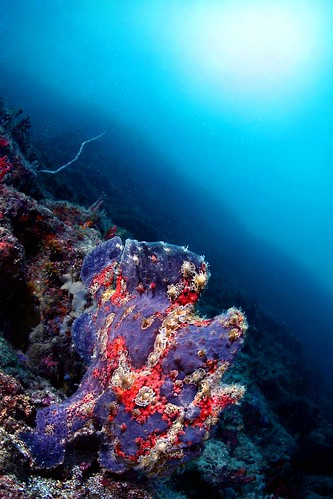
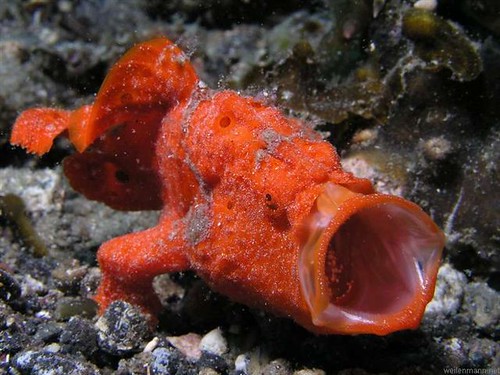
Frogfish are some of the most bizarre looking fish in the ocean. They are a type of angler fish with amazing adaptations for camouflage. Their bodies are oddly shaped and they can change colors to blend in with their environment. Most frogfish mimic corals, sponges, seaweed, or rocks. This camouflage keeps predators from identifying them as food, and it keeps their food from identifying them as predators.


Frogfish spend most of their lives scooting along the bottom of the ocean. They lie motionless, resting on specially modified fins that act almost like legs.

Like most angler fish, frogfish have a very clever method of hunting prey. Instead of going out to find their food, they bring their food to them. Frogfish have a small growth on their heads that looks like a small worm or fish. They dangle this lure in front of their mouth, tricking other fish into thinking it is food.


The fish come close, thinking they will eat an easy meal. Instead they become the meal for the frogfish.


Frogfish are found in oceans throughout the world, and they take on a staggering variety of shapes and colors.


Monday, February 16, 2009

Sea Snakes

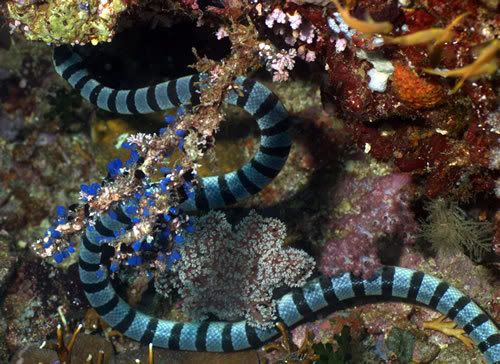
Sea Snakes are some of the many land animals that have adapted to live in the ocean. They seem completely out of place, yet these unusual marine reptiles are perfectly adapted for life below the waves. I'm sure it is hard to picture a snake under water, so I posted the video below of a sea snake gliding across a reef. It seems just as natural swimming underwater as it would slithering on dry land.


There are over 60 different species of sea snakes found in tropical seas throughout the world. Most are brightly colored, and nearly all sea snakes have a flattened tail that works as a paddle. Unlike their terrestrial cousins, many species of sea snakes lack the ability to crawl on land. Others are known to spend a good amount of time out of the water. Sea snakes may live underwater for most of their lives, but they still breathe air like all other reptiles.

The forked tongue of a sea snake is specially adapted to allow them to smell underwater. They cruise along coral reefs hunting fish, eels, shrimp, or even fish eggs depending on the species.

Most sea snakes are highly venomous and pack deadly poison, but few are known to be aggressive towards humans. Attacks are not very frequent, and they rarely deliver much poison when they strike. When sea snakes are handled by humans or caught on land, they can be very dangerous. As with most sea creatures, it is best to look but don't touch.

Sunday, November 30, 2008

Cone Snail Videos

I was happy to see how much attention the post on Cone Snails has gotten. I understand it is hard to picture a snail killing something, so I dug up a couple of videos of these slow but deadly predators on the hunt. It's somewhat disturbing and totally amazing to see these Cone Snails in action.

This is a very good clip from National Geographic showing the full process of a Cone Snail hunting.


And this video from Nature shows how quickly a Cone Snail can subdue a live and very active fish.


One of the reader responses to my previous Cone Snail post asked where Cone Snails can be located. I found a map from National Geographic showing just this.

It's small but you can see the regions where Cone Snails can be found highlighted in yellow. They are mostly located in tropical oceans. Florida is the only place in America that I know of where you can find Cone Snails. Still, if you think you might have found a cone snail, just remember the general rule of the ocean:
When in doubt, don't touch it.

Monday, November 3, 2008

Cone Snails: Deadly Predators

Oddly enough one of the most deadly animals in the entire ocean is a tiny snail called a cone snail. While it seems comical to even think of a snail as dangerous, let alone lethal, cone snails have some of the most sophisticated and deadly neurotoxins known to man. A cone snail sting can kill a person within minutes of injection.

While most snails simply graze on algae, cone snails are active predators. They are fully capable of catching and eating quick and agile fish. These mollusks move just as slowly as other snails, but they pack a hidden weapon. They have a long tube which conceals a deadly harpoon tipped with their powerful venom. They can fire this harpoon with lightning fast accuracy. Their prey is killed almost before even knowing it has been hit. The snail then reels the dead fish into its vacuum-like mouth and swallows it whole.

People are rarely attacked by cone-snails because they do not actively hunt humans. Only about 15 known cone snail related deaths have been reported to date. Most of these incidents occur because people pick up the beautiful shells they see on the ocean floor. When the snail is agitated, it fires its harpoon, and the person often dies within minutes. If you ever see a cone-shaped shell lying on the sand, it's best to just leave it alone.

Monday, October 27, 2008

Puffer Fish

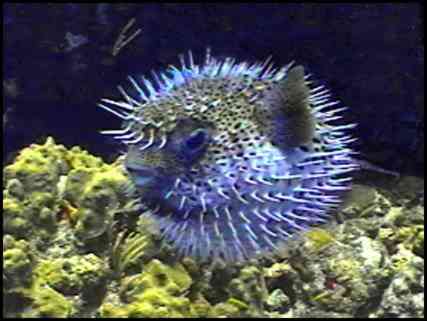
Puffer fish have a very unique defense mechanism. They are able to swallow water to inflate their bodies like balloons. Most fish will eat anything that will fit into their mouth, and avoid anything bigger than themselves. By puffing up like this, a puffer fish quickly jumps to a much bigger size, and becomes inedible to most fish.

A puffer fish spends most of its time deflated. In this state, it is much more streamlined and can swim unhindered in search of food. When it puffs up, it moves extremely slowly. I used to catch puffer fish by startling them into puffing up. This made them suddenly almost immobile. I could then easily pick the little ball up with my hands.

If I caught them in a net before they managed to puff up with water, they would fill up with air. This turned them into little living balloons. I would put them on the surface and they would float down the beach until they relaxed and deflated.

Puffer fish come in many colors, shapes, and sizes. Most can easily fit into the palm of your hand, but some grow as big as a person. Some species are decorated with beautiful colors as well.

Friday, October 24, 2008

Jellyfish


Jellyfish are cnidarians, related to sea anemones and sea slugs. They consist of a dome-shaped body and tentacles that trail behind them. Jellyfish are able to swim through the water by pulsing their jelly-like bodies. Their tentacles are covered in poisonous stinging cells called nematocysts. These tentacles can paralyze or kill fish. Some jellyfish, like the box jellyfish below, are powerful enough to kill humans. The venom in a box jellyfish can stop a person's heart in less than 3 minutes.

While most jellyfish are relatively small, some can grow to enormous sizes.

During certain times of year, jellyfish can be found in huge numbers, clouding the seas with their pulsating forms.

Some jellyfish can even glow in the dark.

Wednesday, October 22, 2008

Crabs

Crabs are Crustaceans and members of the Arthropod phylum. They have a hard exoskeleton surrounding their entire bodies which acts as a suit of armor. Most crabs use their powerful claws to fend off attacks and capture prey.

Some species such as the hermit crab scoot into empty snail shells and carry the shell on their backs. When threatened, they can disappear into the shell.

Other species rely on camouflage to hide from predators.

Most species of crabs can survive for short periods of time outside the water. Their shells hold enough water to keep their gills moist, therefore allowing them to breathe on land. Some crabs spend most of their lives on land.

Crabs range in size from barely visible to the giant coconut crab pictured here. Crabs can be found all over the world in a staggering variety of shapes and colors.

Monday, October 20, 2008

Mandarin Goby

One of my favorite fish in the whole ocean is the Mandarin Goby. Its lifestyle and behavior are much like any other goby, but its colors are absolutely stunning.

These vibrant and flashy fish can be found as the centerpiece of many saltwater aquariums. They are heavily sought after because of their beautiful display.


Friday, October 17, 2008

Great White Sharks

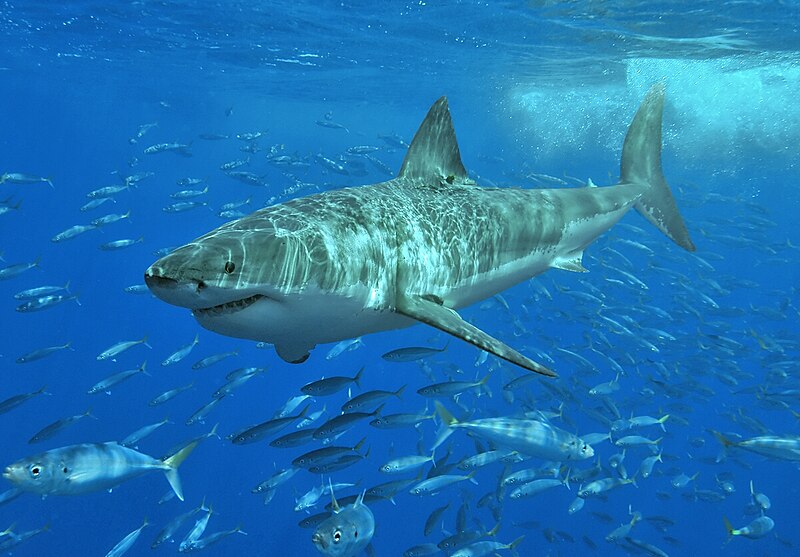
Great White sharks are among the fiercest and most deadly predators in the world. They are among the few species of sharks that have a reputation as man-eaters. They are some of the most efficient and powerful predators in the world. Here is some breathtaking video footage of great white shark attacks from the series "Planet Earth".

[WARNING: Not safe for small children or people who love seals]

Wednesday, October 15, 2008

Dinoflagellates: Bioluminescent Algae

In some oceans when the night is dark enough, you can see the waves glow as the water stirs. This is caused by phytoplankton called dinoflagellates. They give off a soft blue glow when disturbed. The chemicals they use are similar to the ones causing lightning bugs to glow.


When a person swims through the algae, the motion gives off a glow all around them, looking like angel's wings. Boats and wave action can also cause ripples of light to cascade in their wake. This video was taken at a dock in Australia where this algae is plentiful. People throw water on it to cause it to glow in amazing patterns.


Friday, October 10, 2008

Flying Fish

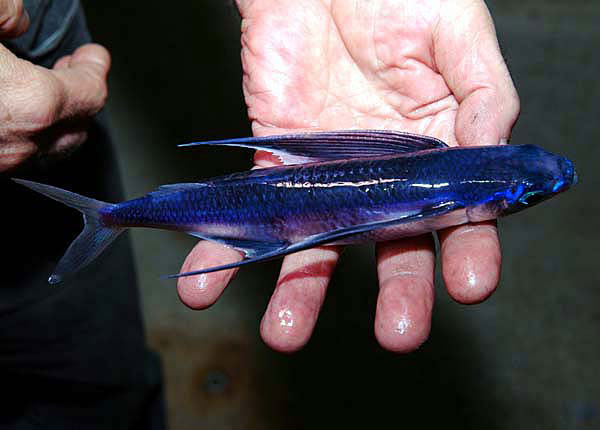
Flying fish are some of the most amazing organisms in the ocean, and believe me there are lots of amazing creatures in the sea. Flying fish have a very unique defense mechanism for escaping predators. They have found that the best way to avoid other fish in the water is to get out of the water. As their name suggests, flying fish can actually leap out of the water and fly short distances.

Flying fish have very specialized pectoral fins (the fins on their sides) which can actually function as wings. While underwater, they fold the fins close to their bodies so they can swim just like normal fish. When a flying fish feels threatened, it will take a running start and jump out of the water.
Some flying fish have been clocked to fly for over 45 seconds, but most flights are relatively short. Like all fish, flying fish still breathe through gills, and must return to water before they run out of oxygen. Still, that quick flight is plenty of time to escape most predators. As far as most fish are concerned, if their prey leaves the water, it is out of reach.