Showing posts with label Unusual Fish. Show all posts

Monday, January 25, 2010

Cuttlefish

Cuttlefish have some of the most incredible camouflage of anything in the animal kingdom. Their highly complex brain allows them to control the cells in their skin to blend in perfectly with their surroundings, or flash colorful displays much like an LED billboard.

The cells on the skin of a cuttlefish are covered in tiny dots of all colors, much like the tiny dots that make up the screen of your computer. A cuttlefish can make their cells grow or shrink to bring out the perfect blend of colors to match whatever is around it.


Its skin can also change shape from its usual smooth texture to whatever matches its surroundings. When it combines its color and texture adaptation, a cuttlefish can become nearly invisible even in plain sight. Because it can change its camouflage almost instantly, cuttlefish are very good at stalking prey, or avoiding becoming a meal themselves.

Cuttlefish are excellent predators, feeding on small fish and crustaceans. They will sneak up on their prey until they are close enough to strike, then shoot out two of their longest tentacles like harpoons to grab onto their prey with their suction cups. Then they reel their victim back into their mouth. Cuttlefish will also sometimes flash waving patterns of bright colors to confuse their prey while they move in for the kill.

Cuttlefish are not actually fish as their name implies. They are mollusks, close relatives of octopus and squid. Unlike their boneless cousins, cuttlefish have an internal shell which acts a skeleton to help them hold their shape. Cuttlefish shells are often sold at pet stores as calcium supplements for birds.

Cuttlefish use their skin for more than just camouflage. They can also use their amazing control of color to communicate. They often change to bright colors when they are angry to warn other sea creatures or other cuttlefish to stay away. They also use their arms to communicate, holding them in certain positions as if they are using sign language.

I once found a cuttlefish while I was snorkeling in Cozumel. Unlike most marine life, it seemed genuinely curious about me. I swam in close and moved my fingers into the position it had its tentacles in. It waved its arms back and flashed bright colors at me as if it was trying to carry on a conversation. After a few minutes, the cuttlefish darted away and disappeared. I still wonder if I said something mean or just wasn't much fun to talk to.


Sunday, April 5, 2009

Frogfish


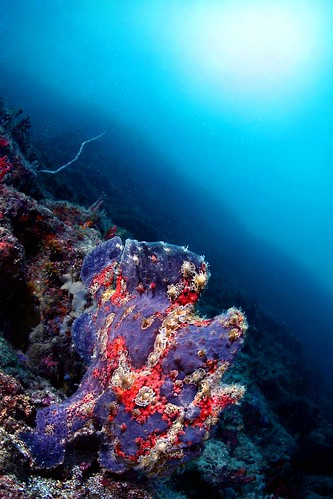
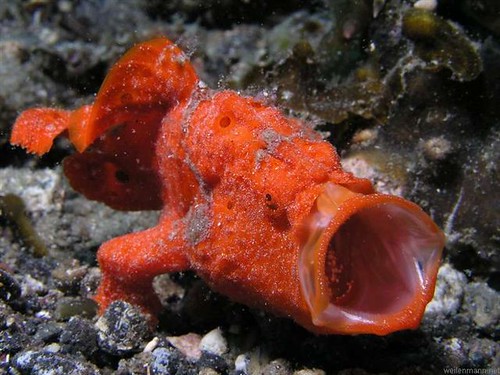
Frogfish are some of the most bizarre looking fish in the ocean. They are a type of angler fish with amazing adaptations for camouflage. Their bodies are oddly shaped and they can change colors to blend in with their environment. Most frogfish mimic corals, sponges, seaweed, or rocks. This camouflage keeps predators from identifying them as food, and it keeps their food from identifying them as predators.


Frogfish spend most of their lives scooting along the bottom of the ocean. They lie motionless, resting on specially modified fins that act almost like legs.

Like most angler fish, frogfish have a very clever method of hunting prey. Instead of going out to find their food, they bring their food to them. Frogfish have a small growth on their heads that looks like a small worm or fish. They dangle this lure in front of their mouth, tricking other fish into thinking it is food.


The fish come close, thinking they will eat an easy meal. Instead they become the meal for the frogfish.


Frogfish are found in oceans throughout the world, and they take on a staggering variety of shapes and colors.


Monday, October 27, 2008

Puffer Fish

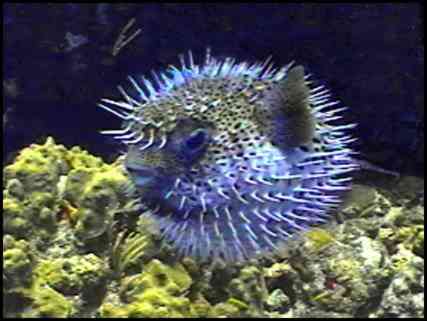
Puffer fish have a very unique defense mechanism. They are able to swallow water to inflate their bodies like balloons. Most fish will eat anything that will fit into their mouth, and avoid anything bigger than themselves. By puffing up like this, a puffer fish quickly jumps to a much bigger size, and becomes inedible to most fish.

A puffer fish spends most of its time deflated. In this state, it is much more streamlined and can swim unhindered in search of food. When it puffs up, it moves extremely slowly. I used to catch puffer fish by startling them into puffing up. This made them suddenly almost immobile. I could then easily pick the little ball up with my hands.

If I caught them in a net before they managed to puff up with water, they would fill up with air. This turned them into little living balloons. I would put them on the surface and they would float down the beach until they relaxed and deflated.

Puffer fish come in many colors, shapes, and sizes. Most can easily fit into the palm of your hand, but some grow as big as a person. Some species are decorated with beautiful colors as well.

Monday, October 20, 2008

Mandarin Goby

One of my favorite fish in the whole ocean is the Mandarin Goby. Its lifestyle and behavior are much like any other goby, but its colors are absolutely stunning.

These vibrant and flashy fish can be found as the centerpiece of many saltwater aquariums. They are heavily sought after because of their beautiful display.


Friday, October 10, 2008

Flying Fish

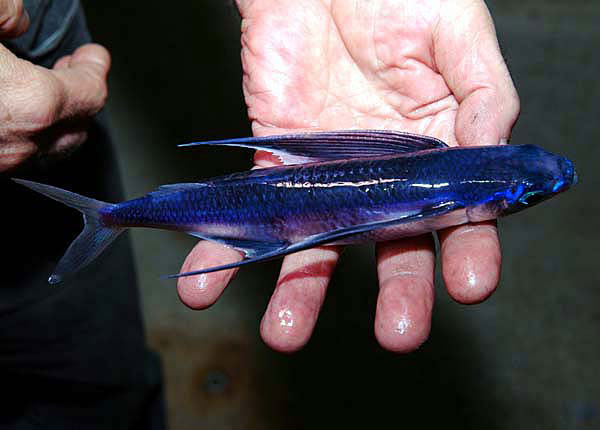
Flying fish are some of the most amazing organisms in the ocean, and believe me there are lots of amazing creatures in the sea. Flying fish have a very unique defense mechanism for escaping predators. They have found that the best way to avoid other fish in the water is to get out of the water. As their name suggests, flying fish can actually leap out of the water and fly short distances.

Flying fish have very specialized pectoral fins (the fins on their sides) which can actually function as wings. While underwater, they fold the fins close to their bodies so they can swim just like normal fish. When a flying fish feels threatened, it will take a running start and jump out of the water.
Some flying fish have been clocked to fly for over 45 seconds, but most flights are relatively short. Like all fish, flying fish still breathe through gills, and must return to water before they run out of oxygen. Still, that quick flight is plenty of time to escape most predators. As far as most fish are concerned, if their prey leaves the water, it is out of reach.

Wednesday, October 8, 2008

World's Deepest Fish


Scientists have discovered fish living nearly 5 miles below the surface of the ocean. There is no light at this depth, and the pressure is enough to easily crush nearly any living thing. The pressure is about as much as the weight of 1,600 elephants. The water temperature is nearly freezing. It seems impossible that anything could survive in these conditions, yet there is life here.

This species of snailfish is able to thrive in large numbers in this extreme environment. Scientists had to specially design the camera equipment so it wouldn't be destroyed by the crushing pressure. It was previously inconceivable that anything could live at such depths, but it seems that no matter where we search on earth, there is always life.