Showing posts with label Fish. Show all posts

Sunday, April 5, 2009

Frogfish


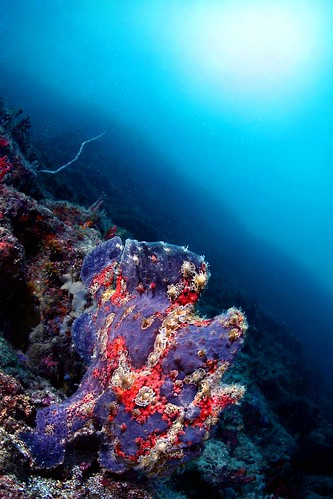
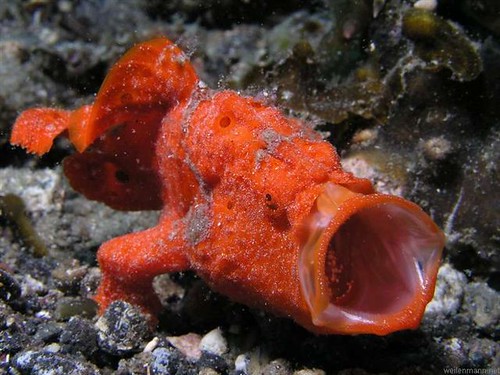
Frogfish are some of the most bizarre looking fish in the ocean. They are a type of angler fish with amazing adaptations for camouflage. Their bodies are oddly shaped and they can change colors to blend in with their environment. Most frogfish mimic corals, sponges, seaweed, or rocks. This camouflage keeps predators from identifying them as food, and it keeps their food from identifying them as predators.


Frogfish spend most of their lives scooting along the bottom of the ocean. They lie motionless, resting on specially modified fins that act almost like legs.

Like most angler fish, frogfish have a very clever method of hunting prey. Instead of going out to find their food, they bring their food to them. Frogfish have a small growth on their heads that looks like a small worm or fish. They dangle this lure in front of their mouth, tricking other fish into thinking it is food.


The fish come close, thinking they will eat an easy meal. Instead they become the meal for the frogfish.


Frogfish are found in oceans throughout the world, and they take on a staggering variety of shapes and colors.


Thursday, January 29, 2009

Manta Rays

Manta rays are the largest member of the ray family, growing up to 25 feet across. While most fish swim, rays fly gracefully through the water by flapping the edges of their fins like wings. Rays are actually relatives of sharks.

Manta rays are a favorite among divers because they are so large and beautiful, but also very gentle. They are said to often become curious about divers and interact with them. They have the largest brain-to-body ratio of any of the shark family. They are also sometimes found in groups or even large schools.

Manta rays are sometimes referred to as devil rays because of the hornlike projections around their mouths. These are actually used to funnel food into their gaping mouths. They feed exclusively on plankton, which they scoop into their mouths as they glide along the currents. Manta rays swim slowly, often doing loops and dives as they seek out plankton.

With their huge wingspan, one often wonders if they could fly. In some ways, they do. Rays have been observed leaping completely out of the water for short periods of time. Naturally gravity takes its toll but they get some considerable air time before plunging back under the waves.

If you want to see a giant manta ray in person, you can find one swimming along with 3 whale sharks in the Georgia Aquarium. I got to watch this graceful giant up close on my recent visit there.

Monday, October 20, 2008

Mandarin Goby

One of my favorite fish in the whole ocean is the Mandarin Goby. Its lifestyle and behavior are much like any other goby, but its colors are absolutely stunning.

These vibrant and flashy fish can be found as the centerpiece of many saltwater aquariums. They are heavily sought after because of their beautiful display.


Friday, October 10, 2008

Flying Fish

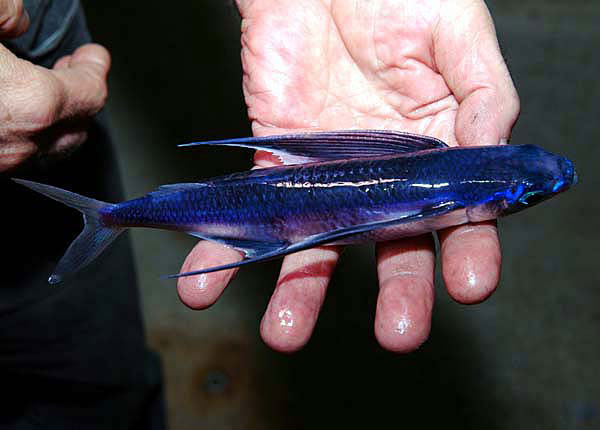
Flying fish are some of the most amazing organisms in the ocean, and believe me there are lots of amazing creatures in the sea. Flying fish have a very unique defense mechanism for escaping predators. They have found that the best way to avoid other fish in the water is to get out of the water. As their name suggests, flying fish can actually leap out of the water and fly short distances.

Flying fish have very specialized pectoral fins (the fins on their sides) which can actually function as wings. While underwater, they fold the fins close to their bodies so they can swim just like normal fish. When a flying fish feels threatened, it will take a running start and jump out of the water.
Some flying fish have been clocked to fly for over 45 seconds, but most flights are relatively short. Like all fish, flying fish still breathe through gills, and must return to water before they run out of oxygen. Still, that quick flight is plenty of time to escape most predators. As far as most fish are concerned, if their prey leaves the water, it is out of reach.

Wednesday, October 8, 2008

World's Deepest Fish


Scientists have discovered fish living nearly 5 miles below the surface of the ocean. There is no light at this depth, and the pressure is enough to easily crush nearly any living thing. The pressure is about as much as the weight of 1,600 elephants. The water temperature is nearly freezing. It seems impossible that anything could survive in these conditions, yet there is life here.

This species of snailfish is able to thrive in large numbers in this extreme environment. Scientists had to specially design the camera equipment so it wouldn't be destroyed by the crushing pressure. It was previously inconceivable that anything could live at such depths, but it seems that no matter where we search on earth, there is always life.

Wednesday, October 1, 2008

Sharks

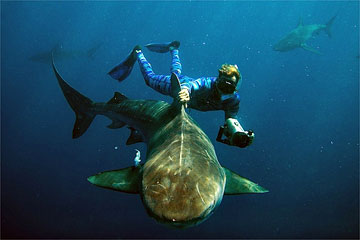
Sharks are the most effective and deadly predators in the oceans of our world. Sharks are perfectly designed aquatic killing machines. There are over 360 known species of sharks, ranging from the tiny dogfish to the massive whale shark.

The bodies of sharks are perfectly designed for quick and decisive strikes. They are streamlined for speed and power in swimming. A shark's skin is covered in tiny teeth which face forward, causing a layer of turbulence around their bodies and making them even more streamlined. The high tech racing suits worn by many swimmers in the Olympics were designed to mimic a shark's skin.

Most sharks are colored to help them disappear into the water. They are a dull gray and darker on top to blend into the deep waters when looking down at them. Their undersides are light, blending in with the light water above.

Sharks have heightened sense organs to help them find prey. These sense organs are packed into their snouts. This causes their noses to be very sensitive. Sharks can often be warded off by a sharp blow to the nose, which causes them great pain. They can smell even a drop of blood in the water for miles, which is why you should never swim when you are bleeding. When sharks smell blood, they often go into a frenzy, lashing wildly at anything that moves. Sharks also have electric receptors and can sense the tiny electric fields emitted by living things. When an animal panics or is afraid, their electrical signals increase and sharks can sense it. This is why it is said that sharks can sense fear. In a way, they can. They can read the heightened electrical activity in terrified prey, and it makes them more likely to attack.

Sharks have massive jaws that actually unhinge to allow them to take huge bites. When a shark bites, its eyes actually sink back in their head to protect them from thrashing enemies and their sharp claws or fins. Their strong jaws are lined with rows of thousands of razor sharp teeth which continually fall out and are replaced.

Man has always feared sharks, but they actually don't normally hunt humans. A shark prefers oily, fatty fish and seals for a meal. Sharks also tend to feed on weak or injured sea creatures. They rarely bother attacking healthy animals unless they are very hungry. Sharks are attracted to blood, splashing, and fear. Each of these things tells a shark that the animal is hurt, and will be an easy meal. If you ever see a shark, stay calm and relax. It will usually just check you out, then leave you alone.
Most shark attacks are a case of mistaken identity. Humans surfing in wetsuits look very similar to seals, which are some of their favorite prey. In the entire world, there are an average of only about 50 shark attacks each year. Only about 5 of these are fatal. On the other hand, there are an average of 520,000 murders worldwide each year. We are over 100,000 times more likely to be killed by a human attack than a shark attack, and we go out in human infested areas each day. So don't let sharks scare you out of the water.

Monday, September 22, 2008

Fish

When you think of creatures in the ocean, Fish are probably the first thing that comes to mind. Fish are some of the most populous and successful organisms in the ocean. They are fast, big, and perfectly suited for life in the sea. They are members of the phylum Chordata, meaning they have a backbone and spinal cord. Fish eat anything from algae and plankton to huge marine mammals.

Fish are some of the most diverse and populous organisms on our planet. Fish range in size from tiny fish we can barely see with our naked eye, to the giant whale shark, which dwarfs humans. Fish are spread throughout the oceans of our world and can be found in all seas except the Dead Sea (which is too salty to support any life). Fish can live anywhere from the hot tropical seas to the frigid arctic ocean. Fish have been found from the shallows of tide pools to the deepest reaches of the ocean humans have been able to explore.

I will cover some of the most beautiful, exotic, and bizarre species of fish over the course of this blog. Keep checking for more updates.