I mentioned in my earlier post that cuttlefish not only use their camouflage to hide, but also to confuse their prey. I finally found a good video of a cuttlefish trying to do this. This is a great example of how quickly the skin of a cuttlefish can change colors too.
In this case its prey is actually a plastic toy put there by a scuba diver, so it's attempts to confuse it don't seem to get much of a response. The only one confused here is the cuttlefish. The next video shows a cuttlefish hunting real fish.
When the diver gets too close, the cuttlefish suddenly switches from hunting prey to camouflaging from what he sees as a predator.
Showing posts with label Ocean Videos. Show all posts
Showing posts with label Ocean Videos. Show all posts
Wednesday, October 27, 2010

Monday, April 27, 2009
Pistol Shrimp
 Pistol Shrimps are tiny creatures with a deadly weapon. They are capable of shooting supersonic blasts from their fingertips with enough force to instantly stun or kill their prey.
You may notice that one claw of a pistol shrimp is much larger than the other, and very strangely shaped. This claw serves as both its lethal weapon, and its voice. This claw can be forcefully snapped shut, shooting a jet of water out at such a high speed that it actually vaporizes the water. This causes a small air bubble to form. The bubble collapses with enough force to send concussive shockwaves capable of stunning and incapacitating prey.
 A pistol shrimp will lie in wait under a rock or in a burrow until food comes along. When it is in range, the shrimp will forcefully snap its oversize claw shut, shooting out sonic waves that incapacitate its prey. The helpless victim is dragged unconscious into the burrow and eaten by the pistol shrimp.
 Another unusual thing about pistol shrimps is that they often allow a fish to live with them. Certain kinds of goby fish often share burrows with pistol shrimp. The fish serves as a guard dog, protecting the shrimp from bigger predators. In return, the pistol shrimp works hard to keep the burrow clean and excavate their home.


Sunday, November 30, 2008
Cone Snail Videos
I was happy to see how much attention the post on Cone Snails has gotten. I understand it is hard to picture a snail killing something, so I dug up a couple of videos of these slow but deadly predators on the hunt. It's somewhat disturbing and totally amazing to see these Cone Snails in action.
This is a very good clip from National Geographic showing the full process of a Cone Snail hunting.
And this video from Nature shows how quickly a Cone Snail can subdue a live and very active fish.
One of the reader responses to my previous Cone Snail post asked where Cone Snails can be located. I found a map from National Geographic showing just this.
 It's small but you can see the regions where Cone Snails can be found highlighted in yellow. They are mostly located in tropical oceans. Florida is the only place in America that I know of where you can find Cone Snails. Still, if you think you might have found a cone snail, just remember the general rule of the ocean:
When in doubt, don't touch it.
This is a very good clip from National Geographic showing the full process of a Cone Snail hunting.
And this video from Nature shows how quickly a Cone Snail can subdue a live and very active fish.
One of the reader responses to my previous Cone Snail post asked where Cone Snails can be located. I found a map from National Geographic showing just this.
 It's small but you can see the regions where Cone Snails can be found highlighted in yellow. They are mostly located in tropical oceans. Florida is the only place in America that I know of where you can find Cone Snails. Still, if you think you might have found a cone snail, just remember the general rule of the ocean:
When in doubt, don't touch it.
Friday, October 17, 2008
Great White Sharks
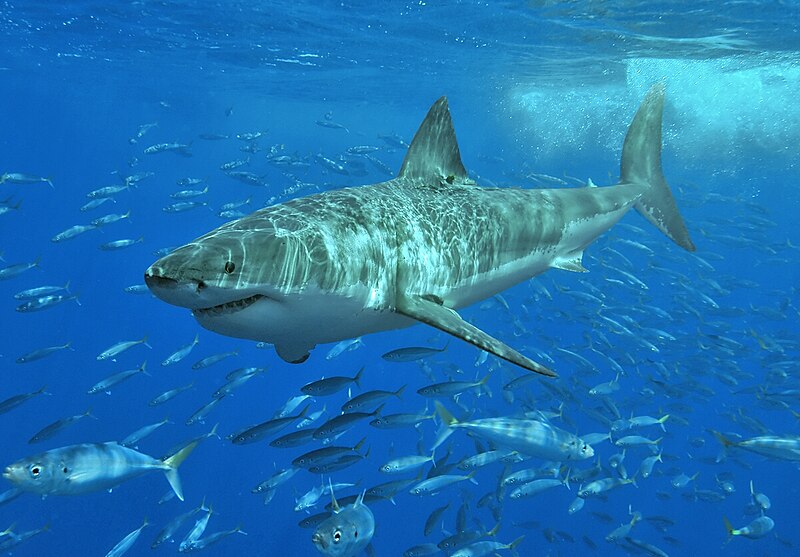 Great White sharks are among the fiercest and most deadly predators in the world. They are among the few species of sharks that have a reputation as man-eaters. They are some of the most efficient and powerful predators in the world. Here is some breathtaking video footage of great white shark attacks from the series "Planet Earth".
[WARNING: Not safe for small children or people who love seals]
Monday, October 13, 2008
Planet Earth Echinoderms Video
This is a clip from the amazing Planet Earth series that aired on the discovery channel. It shows the behavior of some of the echinoderms in the California oceans. You will see starfish, brittle stars, sea urchins, and sand dollars. All of these are members of the echinoderm family. The stop motion photography allows you to see the behavior of these slow moving creatures.
Subscribe to:
Posts (Atom)


