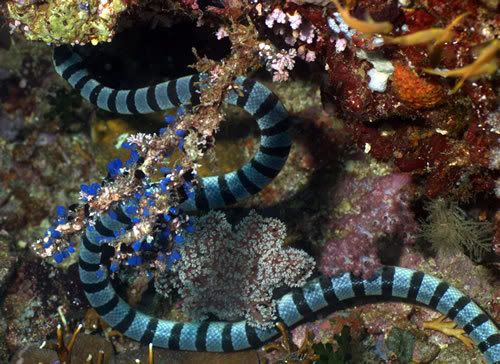
 Sea Snakes are some of the many land animals that have adapted to live in the ocean. They seem completely out of place, yet these unusual marine reptiles are perfectly adapted for life below the waves. I'm sure it is hard to picture a snake under water, so I posted the video below of a sea snake gliding across a reef. It seems just as natural swimming underwater as it would slithering on dry land.
There are over 60 different species of sea snakes found in tropical seas throughout the world. Most are brightly colored, and nearly all sea snakes have a flattened tail that works as a paddle. Unlike their terrestrial cousins, many species of sea snakes lack the ability to crawl on land. Others are known to spend a good amount of time out of the water. Sea snakes may live underwater for most of their lives, but they still breathe air like all other reptiles.
 The forked tongue of a sea snake is specially adapted to allow them to smell underwater. They cruise along coral reefs hunting fish, eels, shrimp, or even fish eggs depending on the species.
 Most sea snakes are highly venomous and pack deadly poison, but few are known to be aggressive towards humans. Attacks are not very frequent, and they rarely deliver much poison when they strike. When sea snakes are handled by humans or caught on land, they can be very dangerous. As with most sea creatures, it is best to look but don't touch.