Please visit my new blog on the link below, and let me know what you think of it!
Genesis Nature Blog

 Cuttlefish have some of the most incredible camouflage of anything in the animal kingdom. Their highly complex brain allows them to control the cells in their skin to blend in perfectly with their surroundings, or flash colorful displays much like an LED billboard.

 Cuttlefish are not actually fish as their name implies. They are mollusks, close relatives of octopus and squid. Unlike their boneless cousins, cuttlefish have an internal shell which acts a skeleton to help them hold their shape. Cuttlefish shells are often sold at pet stores as calcium supplements for birds.
 Cuttlefish use their skin for more than just camouflage. They can also use their amazing control of color to communicate. They often change to bright colors when they are angry to warn other sea creatures or other cuttlefish to stay away. They also use their arms to communicate, holding them in certain positions as if they are using sign language.
 I once found a cuttlefish while I was snorkeling in Cozumel. Unlike most marine life, it seemed genuinely curious about me. I swam in close and moved my fingers into the position it had its tentacles in. It waved its arms back and flashed bright colors at me as if it was trying to carry on a conversation. After a few minutes, the cuttlefish darted away and disappeared. I still wonder if I said something mean or just wasn't much fun to talk to.
 Pistol Shrimps are tiny creatures with a deadly weapon. They are capable of shooting supersonic blasts from their fingertips with enough force to instantly stun or kill their prey.
 A pistol shrimp will lie in wait under a rock or in a burrow until food comes along. When it is in range, the shrimp will forcefully snap its oversize claw shut, shooting out sonic waves that incapacitate its prey. The helpless victim is dragged unconscious into the burrow and eaten by the pistol shrimp.
 Another unusual thing about pistol shrimps is that they often allow a fish to live with them. Certain kinds of goby fish often share burrows with pistol shrimp. The fish serves as a guard dog, protecting the shrimp from bigger predators. In return, the pistol shrimp works hard to keep the burrow clean and excavate their home.


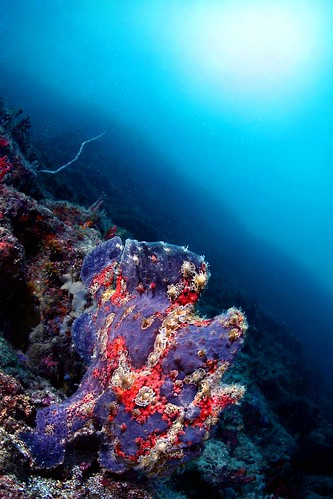 Like most angler fish, frogfish have a very clever method of hunting prey. Instead of going out to find their food, they bring their food to them. Frogfish have a small growth on their heads that looks like a small worm or fish. They dangle this lure in front of their mouth, tricking other fish into thinking it is food.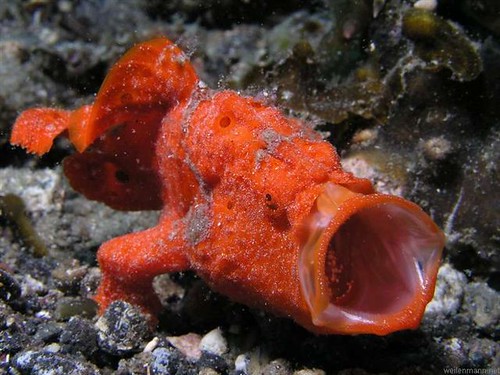


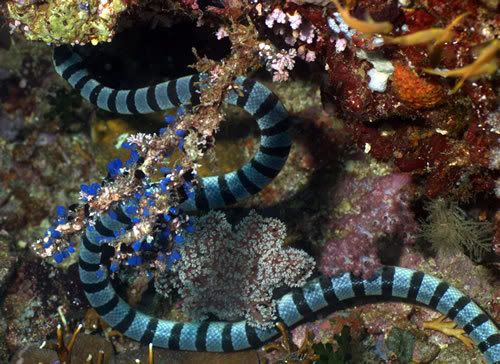 Sea Snakes are some of the many land animals that have adapted to live in the ocean. They seem completely out of place, yet these unusual marine reptiles are perfectly adapted for life below the waves. I'm sure it is hard to picture a snake under water, so I posted the video below of a sea snake gliding across a reef. It seems just as natural swimming underwater as it would slithering on dry land.
 The forked tongue of a sea snake is specially adapted to allow them to smell underwater. They cruise along coral reefs hunting fish, eels, shrimp, or even fish eggs depending on the species.
 Most sea snakes are highly venomous and pack deadly poison, but few are known to be aggressive towards humans. Attacks are not very frequent, and they rarely deliver much poison when they strike. When sea snakes are handled by humans or caught on land, they can be very dangerous. As with most sea creatures, it is best to look but don't touch.
 Manta rays are the largest member of the ray family, growing up to 25 feet across. While most fish swim, rays fly gracefully through the water by flapping the edges of their fins like wings. Rays are actually relatives of sharks.
 Manta rays are a favorite among divers because they are so large and beautiful, but also very gentle. They are said to often become curious about divers and interact with them. They have the largest brain-to-body ratio of any of the shark family. They are also sometimes found in groups or even large schools.
 Manta rays are sometimes referred to as devil rays because of the hornlike projections around their mouths. These are actually used to funnel food into their gaping mouths. They feed exclusively on plankton, which they scoop into their mouths as they glide along the currents. Manta rays swim slowly, often doing loops and dives as they seek out plankton.
 With their huge wingspan, one often wonders if they could fly. In some ways, they do. Rays have been observed leaping completely out of the water for short periods of time. Naturally gravity takes its toll but they get some considerable air time before plunging back under the waves.
 If you want to see a giant manta ray in person, you can find one swimming along with 3 whale sharks in the Georgia Aquarium. I got to watch this graceful giant up close on my recent visit there.
 It's small but you can see the regions where Cone Snails can be found highlighted in yellow. They are mostly located in tropical oceans. Florida is the only place in America that I know of where you can find Cone Snails. Still, if you think you might have found a cone snail, just remember the general rule of the ocean:
 Oddly enough one of the most deadly animals in the entire ocean is a tiny snail called a cone snail. While it seems comical to even think of a snail as dangerous, let alone lethal, cone snails have some of the most sophisticated and deadly neurotoxins known to man. A cone snail sting can kill a person within minutes of injection.
 While most snails simply graze on algae, cone snails are active predators. They are fully capable of catching and eating quick and agile fish. These mollusks move just as slowly as other snails, but they pack a hidden weapon. They have a long tube which conceals a deadly harpoon tipped with their powerful venom. They can fire this harpoon with lightning fast accuracy. Their prey is killed almost before even knowing it has been hit. The snail then reels the dead fish into its vacuum-like mouth and swallows it whole.
 People are rarely attacked by cone-snails because they do not actively hunt humans. Only about 15 known cone snail related deaths have been reported to date. Most of these incidents occur because people pick up the beautiful shells they see on the ocean floor. When the snail is agitated, it fires its harpoon, and the person often dies within minutes. If you ever see a cone-shaped shell lying on the sand, it's best to just leave it alone.
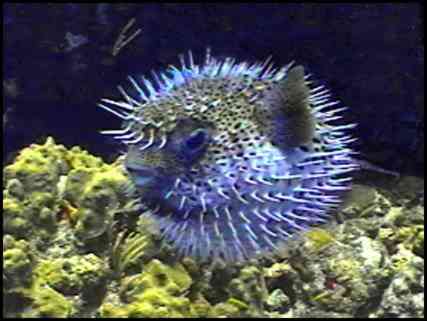
 Puffer fish have a very unique defense mechanism. They are able to swallow water to inflate their bodies like balloons. Most fish will eat anything that will fit into their mouth, and avoid anything bigger than themselves. By puffing up like this, a puffer fish quickly jumps to a much bigger size, and becomes inedible to most fish.
 A puffer fish spends most of its time deflated. In this state, it is much more streamlined and can swim unhindered in search of food. When it puffs up, it moves extremely slowly. I used to catch puffer fish by startling them into puffing up. This made them suddenly almost immobile. I could then easily pick the little ball up with my hands.
 If I caught them in a net before they managed to puff up with water, they would fill up with air. This turned them into little living balloons. I would put them on the surface and they would float down the beach until they relaxed and deflated.
 Puffer fish come in many colors, shapes, and sizes. Most can easily fit into the palm of your hand, but some grow as big as a person. Some species are decorated with beautiful colors as well.


 While most jellyfish are relatively small, some can grow to enormous sizes.
 During certain times of year, jellyfish can be found in huge numbers, clouding the seas with their pulsating forms.
 Some jellyfish can even glow in the dark.
 Crabs are Crustaceans and members of the Arthropod phylum. They have a hard exoskeleton surrounding their entire bodies which acts as a suit of armor. Most crabs use their powerful claws to fend off attacks and capture prey.
 Some species such as the hermit crab scoot into empty snail shells and carry the shell on their backs. When threatened, they can disappear into the shell.
 Other species rely on camouflage to hide from predators.
 Most species of crabs can survive for short periods of time outside the water. Their shells hold enough water to keep their gills moist, therefore allowing them to breathe on land. Some crabs spend most of their lives on land.
 Crabs range in size from barely visible to the giant coconut crab pictured here. Crabs can be found all over the world in a staggering variety of shapes and colors.


